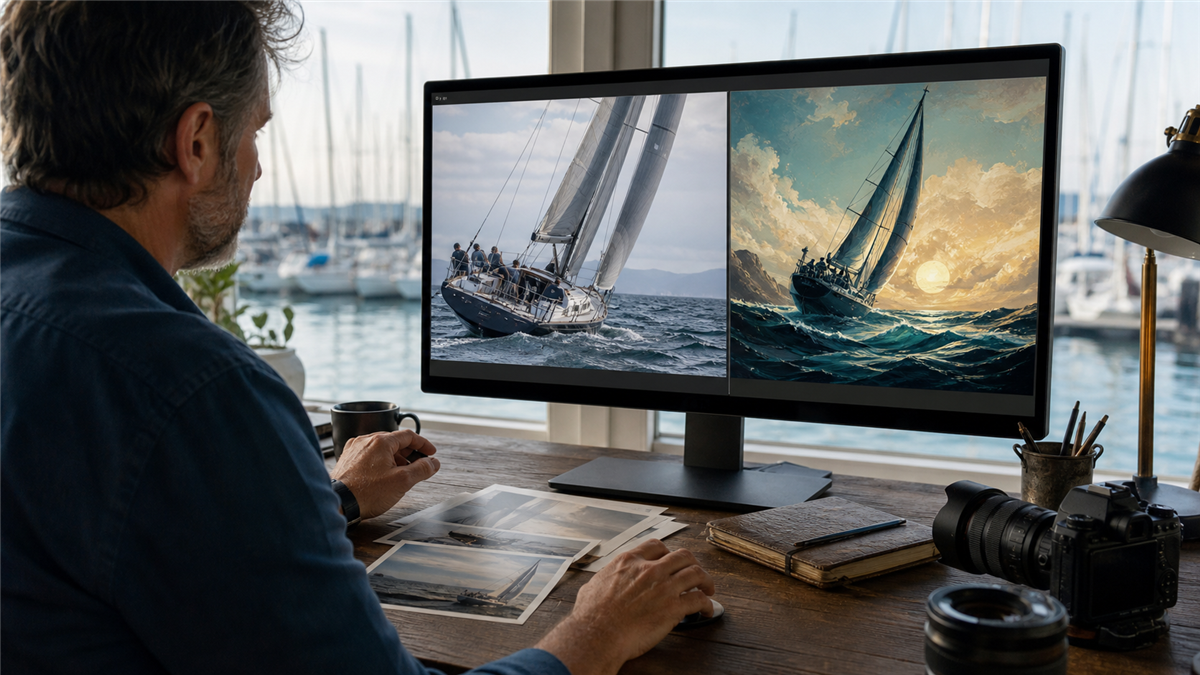
A sailing story earns its authority from the things a reader can recognize: the angle of a heel, the spray on a bow, the light that arrived at the end of a race. Those details are why documentary coverage matters. They are also why a publication needs a clear line between a photograph made at an event and a visual made later to explain an idea.
AI-assisted illustration can have a useful place in a club feature, a history piece, or a guide to tactics. It can make an abstract point easier to see. It should not be allowed to borrow the authority of a photograph that records a real boat, crew, or moment. A short editorial workflow gives photographers and editors room for creative work without making the reader guess what is real coverage and what is an illustration.
Start by naming the job of the visual
A documentary event photograph is made to show something that occurred. Its caption should identify the subject, event, place, and photographer as accurately as the available reporting allows. Reasonable tonal or crop adjustments may improve readability, but an editor should be cautious about changes that alter the meaning of the action or the scene.
An editorial illustration is different. It may be drawn, composited, rendered, or made with an AI image tool, but its job is to clarify an idea rather than claim to show a particular occurrence. A concept visual belongs in the same family: it can help a reader imagine a proposed marina layout, a historical scene, or a teaching example when no documentary photograph can do that job. The distinction needs to be visible in the surrounding story, not left to a hidden file name.
This preserves the value of real coverage. A race report is stronger when it is built around work actually made on the water. Before an event, photographers can use our guide to capturing exceptional sailing competition photos to plan angles, access, and a practical coverage list. An illustration is a supplement for a different editorial job, not a fallback that pretends to be an event image.
Use a five-question editorial check
Before a visual is added to a sailing story, an editor can ask five questions. First, what does the reader need to understand here? Second, is there a real photograph that can answer that need more honestly? Third, if an illustration is still useful, can its caption identify it in ordinary language? Fourth, are the original photographs, source materials, and editorial notes stored so the team can revisit the decision? Finally, has a person who understands the story checked the image in context?
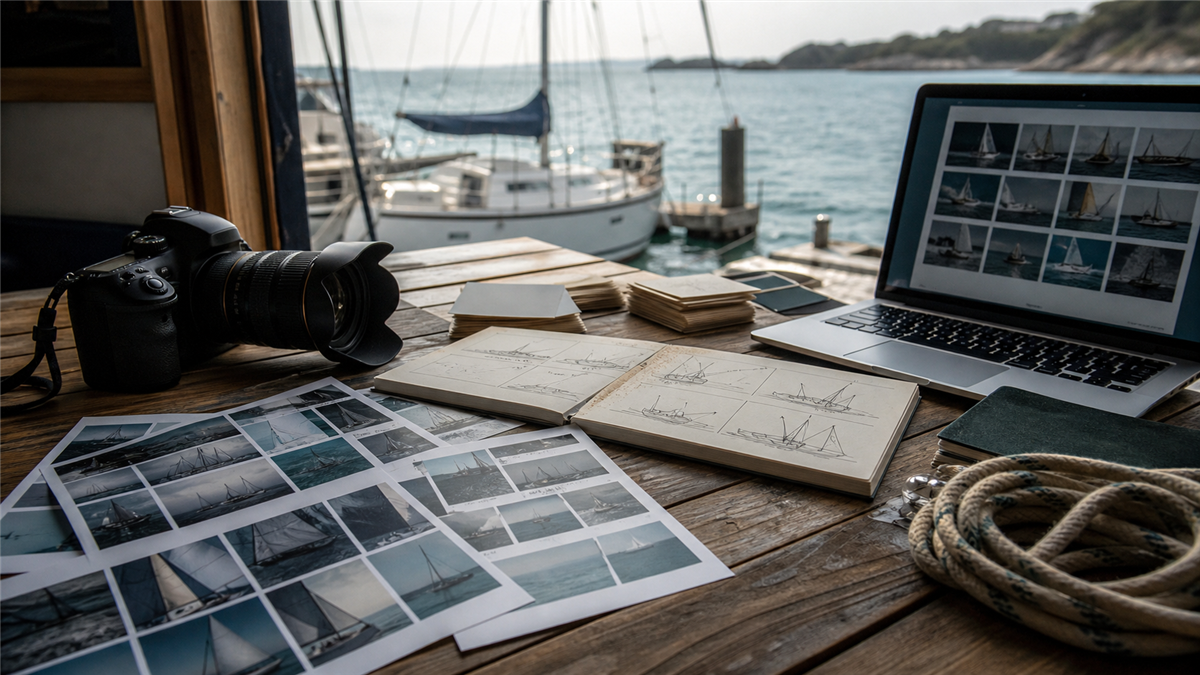
The fourth question is about practical record-keeping, not a promise that every platform preserves every file detail. Retaining original camera files where available, versions used in the layout, and a short note about why an illustration was selected gives a small team a reliable editorial memory. It also prevents a concept image from becoming detached from its label when it is reused later.
Make the label part of the reading experience
A reader should not need specialist knowledge to understand what they are seeing. Put a plain label in the caption or immediately adjacent copy, such as “Editorial illustration,” “Concept rendering,” or “AI-assisted illustration for this article.” Use wording that fits what was actually made. If the image is a composite of documentary photographs, say so. If it is a stylized visual that does not depict a real event, say that too.
Do not rely on a subtle watermark, a tooltip, or a disclosure page elsewhere on the site. Those approaches can disappear in a social crop, a newsletter excerpt, or a screenshot. A nearby caption travels better with the story and is kinder to a reader who arrives directly on the image.
A quick decision table for editors
| When the story needs | Best starting visual | Editorial action | Caption approach |
|---|---|---|---|
| A record of a finish, crew, or weather on the day | Documentary event photograph | Use the strongest accurately captioned frame | Identify event, subject, and photographer where known |
| An explanation of trim, tactics, or a visual idea | Diagram or editorial illustration | Keep the explanatory purpose clear in the story | State that it is an illustration or diagram |
| A future, hypothetical, or historical scene | Concept visual | Check that it cannot be mistaken for current coverage | State that it is a concept visual and not event coverage |
Pair visible context with useful provenance information
Visible labeling remains the first reader-facing safeguard. Technical provenance information can add context when tools and platforms support it, but it should not carry the whole burden. The C2PA specification describes a technical approach to recording content provenance. Adobe explains that Content Credentials can include information about a creator and how a work was made on supported platforms.
That information is useful context, not a guarantee of ownership, licensing, consent, truth, or authenticity. It may not appear in every place an image is shared. The practical decision still belongs with the editor: ensure that the story and caption describe the visual honestly, and keep enough internal notes for the team to explain the choice later.
For a broader risk conversation, the NIST AI Risk Management Framework is a helpful starting point for thinking about governance and documentation. Visual journalists can also use the NPPA Code of Ethics as a reader-first reference when deciding whether an alteration or presentation might mislead.

Use AI illustration as an explanation, never a substitute
Some sailing stories benefit from a visual that real coverage cannot supply. A guide to how wind direction changes a composition, for example, may be easier to follow with a clearly marked concept illustration. In that narrow role, design choices still matter. A practical guide to making AI images look more realistic can help an editor refine a clearly labeled creative illustration or concept visual; it should never be used to make an invented image stand in for a real event photograph.
The same discipline improves ordinary photography. Our overview of nautical photography techniques and the 7 Cs focuses on the craft decisions that give real coverage clarity in difficult light and movement. Keeping that work at the center is the most reliable way to build a recognizable visual voice.
Questions photographers ask
Can an AI illustration appear in a race report?
It can support a specific explanatory point, but it should be visibly labeled and should not be presented as a photograph from the race. Use real coverage for the account of what happened.
Where should the disclosure go?
Put it in the caption or immediately adjacent story copy. The reader should see it without opening another page, hovering over the image, or reading a footer.
Do technical credentials replace a caption?
No. Credentials can add useful context when they are supported, but a plain-language caption is the clearest way to explain an illustration to the person reading the story.

0 Comments